A few years ago my good friend Kim Park Nelson sent me a link to an article by Erica Maria Cheung for in media res titled “Postcolonial Cozy.” Cheung was referring to the international hit show, Great British Bake Off (in the US it’s known as Great British Baking Show).
My friends know I am a huge fan of GBBO, as the show is fondly known as. I’m an avid amateur baker and when the show first aired in the US I immediately made a list of the bakes shown each episode and began trying to make them. I made Chetna’s cardamom pistachio Swiss roll, and Victoria sponge cakes and from-scratch English muffins and Mary Berry’s cherry cake. I baked florentine cookies and Jaffa cakes.

GBBO has a winning formula – each show has its token quirky characters: a gray-haired older woman who is out of her league with her decades of traditional family-style home bakes; a young person who has exceptional skills for their age; a gay man who is often chided for focusing on design and appearance (as Paul Hollywood would say, “more style than substance”); an at-home mom whose baking is “me-time” from a busy household and raising children; a middle aged dad who is a surprisingly good baker; and an older man, avuncular and cheery whose bakes taste great but are often accused of looking “a mess.”
The show has more sweetness and goo than what’s in the bakes, however. I love that the contestants on GBBO are humble, or at least pretend to be. Unlike US cooking competition shows, contestants don’t say, “I didn’t come here to make friends, I came to win!” These folksy home bakers did come to make friends and often cry during the group hug at the end when one of their friends get eliminated. Instead of trying to sabotage each other, they help them finish when they fall behind and are in danger of not completing their bake.
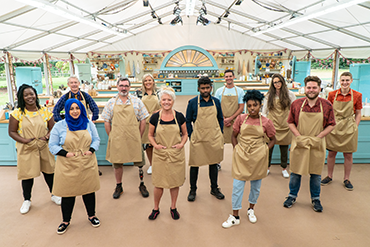
Part of the charm is also in its “diversity” of contestants. In addition to the aforementioned characters who are often white, there are always several contestants who hail from various racial and ethnic backgrounds. Many of the contestants incorporate the “flavors” from their ethnic heritage. Contestants have been Russian, German, Italian, Spanish, and there seems to always be at least one Welsh and one Scottish contestant respectively who are lovingly poked fun at by the comedic hosts for their accents and bakes. In addition, there are always several who have South Asian, Asian, Middle East North African (MENA), African, and/or Caribbean roots.

As Cheung observes, “GBBO provides a happy and comfortable representation of Great Britain as a postcolonial metropole.” That the contestants come from countries formerly under British colonial rule is never discussed outright. Cheung writes, “While under the tent, all bakers are free of their political associations and are on equal footing; they are in a multicultural, postcolonial utopia away from the realities of Brexit and The Daily Mail. However, this utopia is not post-racial. Race still plays an important role in creating a sense of comfort in difference in the GBBO.”
There is no acknowledgment of British imperialism, oppression, racism, and subjugation, just the “spice” to add to the classic British bakes. This is how two white British professional chefs can be the judge of non-British cuisine (such as the notoriously bad Mexican episode). Several times it’s joked that the #1 English dish is chicken tikka masala without reference to the British military and government officials who brought South Asian servants and cooks with them when they returned to the England. Curry take-outs became popularized when they took over abandoned fish and chip stands post-WW2. Sometimes contestants apologize for always using their “spices” as Chetna did in season in season 5. I remember wincing when, in season 9, three contestants with South Asian Indian backgrounds struggled to make garlic naan; Antony explains he comes from a region where they make roti, not naan, and Ruby said, “at least I’m not the worst Indian in the tent.” Later on, Ruby is validated when she makes her mom’s chutney recipe and is praised by Paul and Prue.
Reflecting on GBBO as a postcolonial cozy, where the diversity adds all the charm and none of the oppression made me think of transnational adoption as another form of postcolonial cozy. White parents from global north countries travel to foreign countries to adopt their children. For the first several decades of transnational adoption parents were encouraged to erase any remnant of their child’s ethnic and racial background. However, starting in the 1990s it became almost a bragging point to showcase how adoptive families were valuing diversity by incorporating shallow aspects of their child’s background. We began to see adoptive parents wearing hanboks and eating Ethiopian food and attending Chinese New Year festivals. I’m fascinated by the fact that Prue Leith, one of the current GBBO judges, is also an adoptive mom to a Cambodian adoptee. She is performing post-colonial cozy in multiple ways.
Children are available for transnational adoption because the countries that adopt have ties to the countries that send, facilitated by governments, with the advocacy of adoption agencies and adoptive parents, and NGO’s who aim to rescue children from their orphanhood (social, if not true) and though less acknowledged, from their country (often described in negative terms). And while parents know there are these broader issues and problems aiding their ability to adopt, the family photos do the work of presenting a cozy family story celebrating diversity.
Despite the politic-free, feel-good view of the show, Cheung writes, “what happens when bakers leave the white tent? And what can be said of the “ethnic” foods that fail to fuse?” Contestants with ties to former British colonies as well as all non-British contestants must walk that tightrope between being too ethnic and not ethnic enough.

And how about transnational adoptees? What happens when they leave their white homes? What can be said of their diversity that fails to fuse to their white parents, who vote for lawmakers who want to build walls, deport immigrants who look like them or come from the country they were adopted from, burn and ban books with characters like them, get rid of academic college courses that teach them about their racial and ethnic identities? How do we walk that tightrope between being too ethnic for our families and friends, and not ethnic enough for our ethnic and cultural communities?

 Harlow's Monkey