As part of a larger, long-term project, I’m reading historical books and articles about children who experienced placing-out (foster care or adoption). I am not trained as a historian but I think it’s absolutely necessary to understand the historical roots of placing out, at least in the US context. This is important if we are to understand how we got here – in 2025 – a time when ICWA is being challenged, child abandonment is seen as a viable option to reproductive rights; and people seeking safety and asylum in the US are subjected to having their children taken away; when transnational adoptees are being deported because their adoptive parents failed to obtain their citizenship – we need to know how it started. What were the policies, practices, and cultural values and attitudes then that facilitated where we are now?
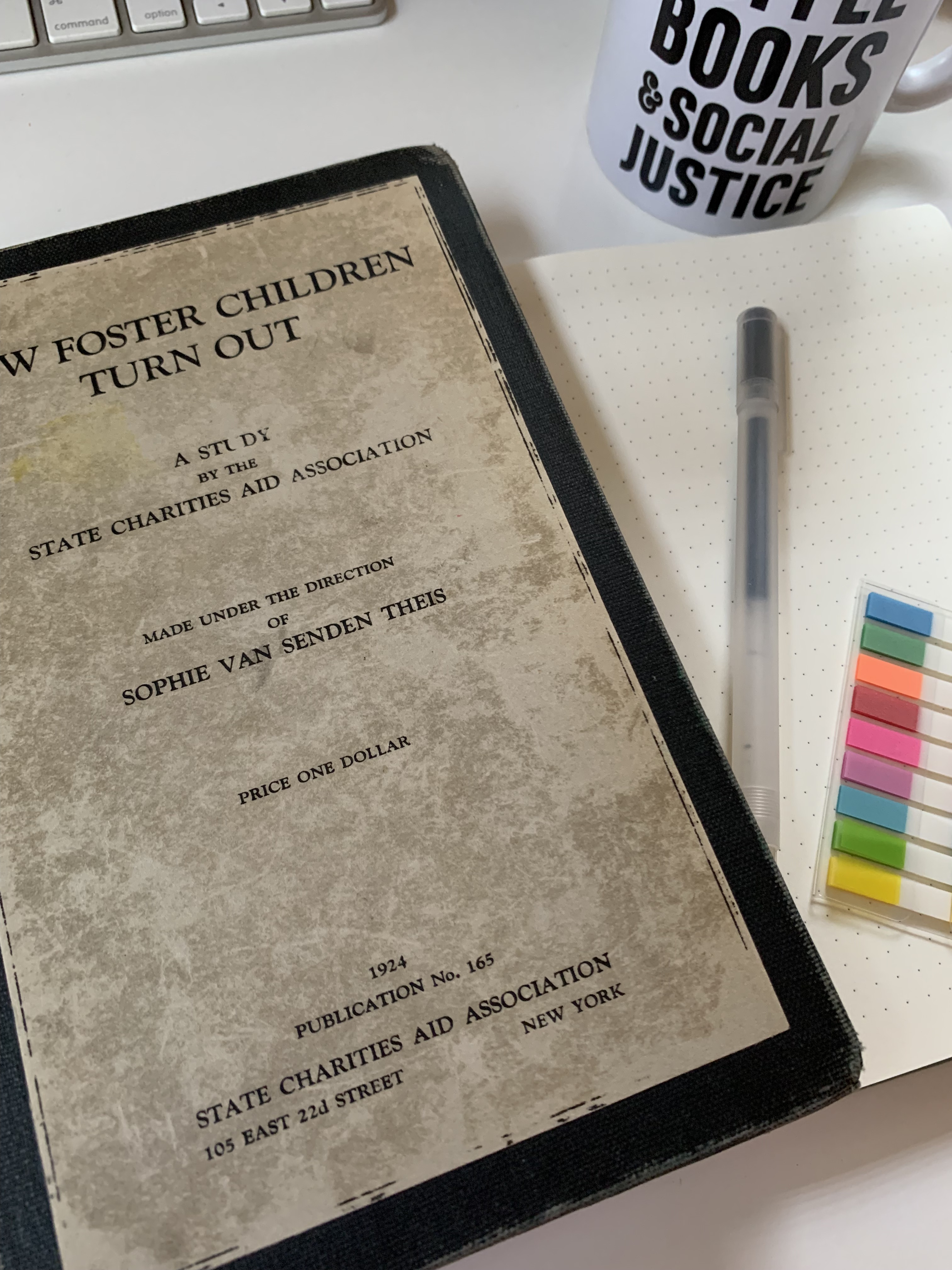
One of the books I read was How Foster Children Turn Out, a report on a study conducted by the State Charities Aid Association in New York in 1924. The study is a follow-up of 910 of the 3,363 children placed by the agency from August 1898 through January 1922. The study was funded by Laura Spelman Rockefeller Memorial Fund and the 910 individuals that were part of this study were all adults ranging in age from 18-40 years old.
The Laura Spelman Rockefeller Memorial philanthropic organization was, at the time of their funding of this specific project, invested in social science research projects. Social work wanted to prove its scientific grounding and promote the field as a professional field, not merely volunteer charity work. Attempting to quantify social behavior in order to run statistical methods as an empirical way to generalize human behaviors and interventions was seen as legitimizing social work research.
The NY State Charities Aid Association wanted to have a data-informed response to questions about placing out; they wanted to provide evidence to counter, as Theis wrote, people’s “drawn conclusions from one or two instances which have come within their experience” (p. 10). This study’s aim was “to find out what kind of people our placed out children had grown to be” (p. 10). Did they grow up to be, in the study’s words, capable (those who are law-abiding, who manage their affairs with good sense and are living in accordance with good moral standards of their community) or incapable (those who are unable or unwilling to support themselves adequately, who are shiftless or have defied the accepted standards of morality or order of their communities)?
Despite the organization’s pride in undertaking a rigorous study, the measures they used are rife with assumptions and biases that fit the time period. There were 16 “field workers” who essentially served as investigators, all of whom had at least some social work experience. They located foster parents or others who could provide current information on the identified former foster child. Workers completed very lengthy forms for each family. I was surprised and kind of impressed that they took the time to ask so many background questions. I thought it was very unrealistic to think they could get full responses from all of the families on all the items. The interviews must have taken a very long time to complete.
The subjectiveness of the notes taken by caseworkers is evident with current viewing. For example, why would it be necessary to provide so many subjective descriptors such as “thick-set, red-faced, healthy looking; laughing eyes” or, “very sturdy, plump figure, heavy, light-brown hair arranged simply, large gray eyes. Full face and rounded features, considerable refinement and a frank expression. Dresses in good taste.”
Apparently, 537 (67.45%) of the now adult foster youth were interviewed, and for those who did not participate in the interviews, updated information was provided by foster parents or others. Sometimes they even interviewed the foster alum’s former employers or determined a former foster child’s capability/incapability through “general reputation in the community” (p. 181).
I mean?? I would be pretty irate to learn that some of my past employers had been contacted and asked to talk about me as part of a study on adoption or foster care.
The conclusion of this study was that most (77.2%) of the placed-out children had become “capable” in adulthood and of those who were considered incapable, 11% were “harmless” meaning they were not considered dangerous to society but merely aimless, unemployed, or depending on others for their livelihood (in their opinions). The main factor for success, in their analysis, was the quality of the relationship between the child and their foster family and that the “human environment matters more than the material surroundings.”
This finding prompted a few reflections. First, I agree the quality of the relationship is important. In my own research adoptee participants described a lack of relational permanence with their adoptive parents despite having formal, legal, and residential “permanence” (terms used by child welfare and legal professionals to define the desired outcome of not being in foster care). In other words, some adoptees say they did not have “quality relationships” with their adoptive parents.
My other reflection based on this finding relates to how many of the children in the original study might have been in an orphanage because of poverty related reasons and had parents who loved them. There is an alarming chapter in this book about families of origin which highlighted to me how long families of origin have been negatively described and marginalized. I wondered if this standard of the quality of the “human environment …more than the material surroundings” standard was applied to first parents.
Reading this book has shown me how little has actually changed in the way we think about children who are placed in foster care or adoptive homes. A lot of data was collected but most of the data were case notes from the field workers, and these were very subjective. When I read outcome studies on formerly fostered adults and adoptees I always look at how the researchers define “successful.” Do those with adoption and foster experiences agree with these definitions?
As I wrote in a presentation I gave in 2012 at the Adoption Initiative conference, “Despite my rough start in life – abandonment, at least two institutional placements, some developmental delays, I stand here today as a symbol of one who “made it.” By the measures that our society most values – I’m married, have two children, an education, a career, I pay taxes – I represent the promise and possibility that adoption works.”
But in that presentation I also argued the way we think about adoptee well-being is limited, misleading, and perpetuates adoption (and foster care) as a means of rescue and rehabilitation. The use of outcome studies has contributed to this tendency to overlook the full story of those of us with adoption and foster experiences. Outcome studies tend to demonstrate “numbers bias” which is the tendency to place more importance on the median experience of a large number of participants and justify neglecting the outliers that don’t fit in within the normative curve. Outcome studies shed light on the “who” and the “what” of a population. Still, because of the structure of this type of research, they often fail at helping us understand deeper nuances and complexities – the “why” and the “how.” And outcome studies flatten and sometimes obscure participants’ experiences.
I remember learning in my social work coursework that children who do not externally express their distress through behaviors (such as aggression) are the ones to worry about because externalized behaviors are evidence of a child’s distress. The quiet child, who is withdrawn and dissociates, often gets ignored and is seen as being “good” because they’re not behaving negatively. As a result, the needs of those who are quiet often get overlooked. Under the guise of being rated as “capable” externally, internally many adoptees may still be struggling.
Outcome studies are one way to see if an intervention “worked.” And yet…most of these outcome studies do not have the ability to actually correlate specific practices with outcomes. Homer Folks wrote in his introduction to the 1924 report, “when very unpromising children seemed to respond to their new and favorable personal and community environment, we were encouraged. When the reverse took place, doubts arose. In how many cases did the favorable results happen, and how many of the unfavorable, and how permanent were these changes? Frankly, we did not know” (p. 4).
This is why we need more research that prioritizes the voices of people with adoption and foster experiences, and why we must stop ourselves from invalidating their experiences to outcome study data. I hope to see more studies where those with lived experience in adoption and foster care define the outcomes that are important to them. Thankfully, there is an increase in this type of research happening, by adoptees via community organizations and from adoptee academics.
In 2024, Hollee McGinnis made the point in her keynote at ICAR-9 conference in Minneapolis that research on adoptees has been happening for over 70 years but no one really explored long-term outcomes of adoptees past mid-life. That is changing, slowly. They’re changing thanks to the increase in adoptees speaking up, writing their stories, sharing their perspectives, and advocating for our community’s needs.
 Harlow's Monkey