
Reflection
Hello! It’s been a while!
I’ve been busy these past several months on adoption-related projects. Since the beginning of 2025 I’ve also intentionally reduced my social media presence while figuring out how I want to engage. Since my last Lab Note we’ve seen several big adoption-related developments including the implementation of The Hague Convention in South Korea and the South Korean president’s apology for the mishandling of its international adoption program.
It’s now also that time of year – National Adoption Month, the yearly campaign to increase adoptions in the United States. For several years now many in the adoptee community have countered with National Adoptee Awareness Month, kicked off by Adoptee Remembrance Day, the Oct. 30th recognition of the adoptees who have died.
In past years, adoptees have used NAM as a way to remind the world that adoptees have a voice and need to be at the center of adoption policies, practices, and media – and not just those adoptees who speak positively about their experiences with adoption. The Flip the Script campaign was started in 2014 by Rosita Gonzales and the Lost Daughters collective. Today, adoptees are using other social media sites to add their own perspectives to NAM.
As I reflect on the almost 1 year break since my last Lab Notes, I’ve been wondering how to best use this blog. The Lab Notes series was started in November 2022 – and it was my idea to provide brief reflections on my research as well as broader conversations in the adoptee community, as well as recommendations and resources. I’ve come to realize that maybe the Lab Notes is too slow of a format for resources since adoptees are finding resources on other platforms like TikTok and Instagram at a faster pace.
This blog will be 20 years old in March and much like me over the past 20 years, things keep changing up! I hope you’ll stick around for whatever comes next. I’ll provide a sneak peek at one thing I’ve been working on for a while.
The Transnational Transcultural Adoption Project is a website I started a couple of years ago after a series of focus groups with transnational adoptees. It’s been one of those slow moving projects, but the main mission is to provide a history of transnational adoption in the U.S. I also reference transnational adoption outside the U.S. but for now, the main focus will be on transnational adoption to the U.S. I’ve been slowly working on a timeline, books, films and resources, and updating the blog portion of the site with news articles related to transnational adoption.
I started this website because I’ve been increasingly concerned and aware of the disappearance of our histories. The recent mentality in some parts of society over the past couple of years is to erase and destroy evidence of the histories of some populations in the U.S. As transnational adoption continues to decrease globally as well as in the U.S., I don’t want to depend on the politics and whims of society or certain politicians for maintaining a historical record of our existence.
I’ve talked about this before, but I was very motivated to start my blog after attending a talk by a former orphan train rider. What struck me was her statement that she was one of the last ones. An estimated 250,000 children were “orphan train riders” from 1853 to 1929. When you think about the timeline of transnational adoptions in the U.S. you are looking at almost the same number of years (1950s to 2025) and approximately twice the number of impacted children (in the U.S.).
Right now, it’s been just me adding to the Transnational Transcultural Adoption Project site but I’ve been working on ideas to incorporate transnational adoptees in a collective history-building format. If you’re a transnational adoptee, I’d love your feedback and ideas! I’m particularly interested in transnational adoption from non-Asian countries since Korea and China adoption dominates so much of the focus on transnational adoption.
Resources
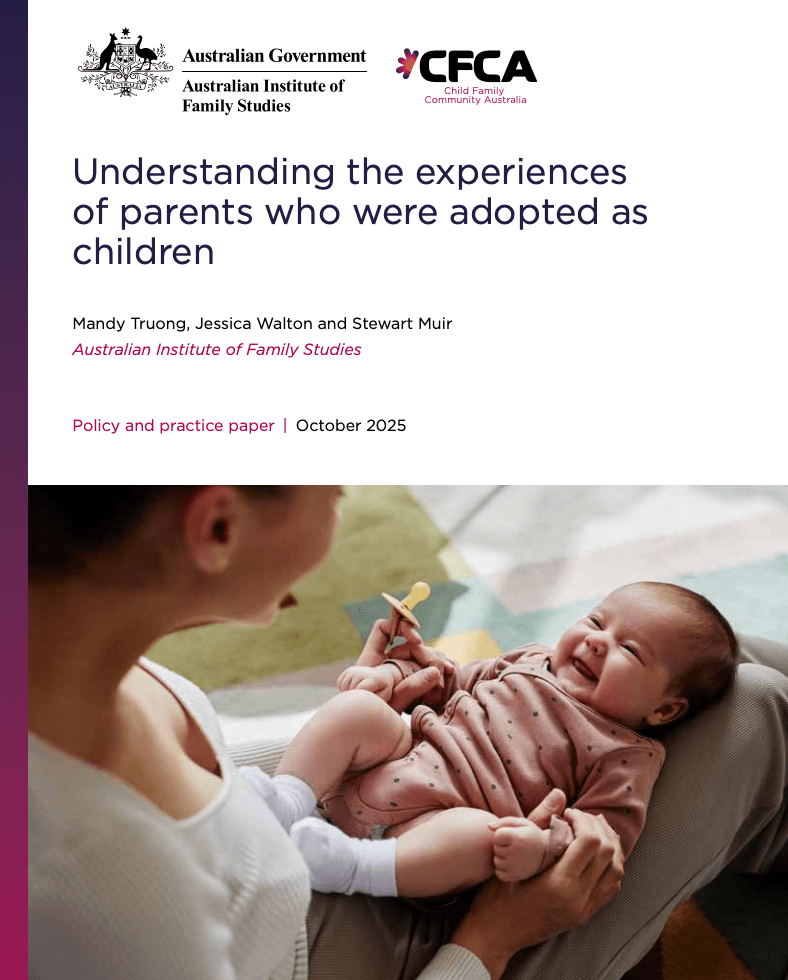
A new publication focused on adoptees as parents was recently released by The Australian Institute of Family Studies. I know at least one of the authors is an adoptee (Jessica Walton). As someone who has written and researched on this topic, I am always eager to see more people doing work in this area. Some of the key takeaways from the report include:
Adoption is a lifelong experience and the growing research is demonstrating that being adopted can impact an adoptees’ relationships with their children.
Adoptee parents can find the parenting experience both rewarding and challenging. Often, becoming a parent prompts adoptee parents to reflect on their own birth experience, and separation and loss from their first parents.
As a result, adoptee parents may need additional support; however, the research on parenting as an adoptee is emergent and more research on what types of support best meets adoptee parents’ needs is also still emerging.
You can download the Understanding the Experiences of Parents who were Adopted as Children report for free.

 Harlow's Monkey
[heart] Bello, Sarah E (DCYF) reacted to your message: